དཔལ་ལྡན་འབྲུག་གཞུང་།། གསོ་བ་ལྷན་ཁག།
Royal Government of Bhutan
Ministry of Health

Menu
About Us-NCTMS
Background
The erstwhile Department of Traditional Medicine Services (DTMS) was established in accordance with the Cabinet’s directives issued vide letter No. C-3/148/398 dated 15th January 2013. The Department was constituted with three functional divisions, including the National Traditional Medicine Hospital (NTMH) and the Menjong Sorig Pharmaceuticals Corporation Limited (MSPCL), to strengthen, coordinate, and advance Traditional Medicine services across the country.
However, in 2022, following the civil service transformation approved by the Lhengye Zhungtshog vide letter No. C-3/133/2022/1485 dated 20th December 2022, the Health Sector Transformation was officially launched on 9th January 2023. As part of the restructuring, the erstwhile DTMS was dissolved and its status was downgraded to a Division of Traditional Medicine (TMD) under the Department of Health Services (DoHS), with clinical services placed under the National Medical Services (NMS). Subsequently, TMD was relocated to the Ministry of Health building on 9th April 2023 and continued to function as one of the divisions under DoHS.
Further, with the implementation of Health Sector Transformation 2.0, and in pursuance of the Health Sector Structural Reform endorsed by the Cabinet vide letter No. C-3/58(6)/2025/651 dated 1st August 2025 approved the formation of the National Center for Traditional Medicine Services along with the approval of the Human Resource Proposal for the 13th Five Year Plan with 3 Functional Divisions and NTMH by the Royal Civil Service Commission (RCSC) vide letter No. RCSC/HRMD/7/2025/3938 dated 31st October 2025, the Ministry of Health has initiated the execution of the approved structural and functional reforms.
Vision
Bhutanese Traditional Medicine as a globally recognised healthcare model which drives holistic health, wellbeing and economic prosperity
Mission
- To deliver evidence-based patient-centered services that promote physical, mental and spiritual well-being.
- To drive professionalism, innovation, research and incorporate best practices.
- To strengthen BTM sector as a driver of economic prosperity through wellness tourism, nature-based industries and job creation.
- To promote global recognition through quality assurance, education and international collaboration.
- To build BTM as a global brand for health and wellbeing aligning with the visions of GMC and other national priorities.
- Accountability
- Honesty
- Equity
- Quality
- Client-centric
- Team spirit
- Sustainability
- Professionalism
- Selflessness
Guiding Principles
- Holism and People-centric
- Preservation and Knowledge Integrity
- Professionalism and Excellence
- Creativity and Innovation
- Collaboration and Partnership
Sustainability
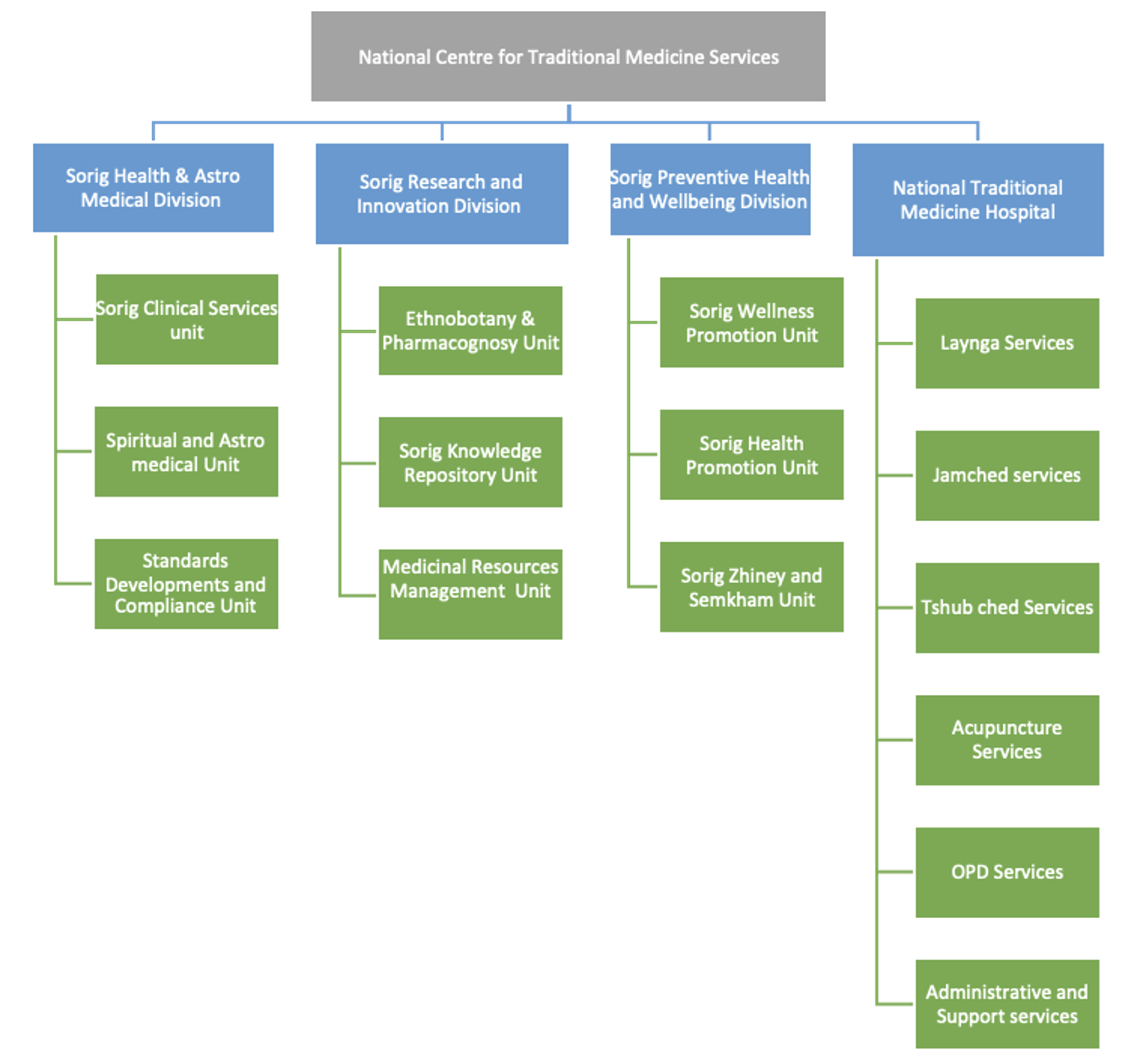
Organogram
Our Mandates
- Ensure the provision of quality traditional medicine services across all levels of healthcare centres;
- Implement national policies and strategies for integrating traditional medicine into the healthcare system, ensuring safety, efficacy, and cultural relevance;
- Promote research on traditional medicine to validate practices, improve formulations, and support evidence-based integration with modern healthcare;
- Document traditional medical knowledge and practices in collaboration with indigenous and local communities to preserve cultural heritage;
- Advocate for the value of traditional medicine in achieving holistic health and well-being, rooted in Bhutan’s cultural and spiritual heritage;
- Engage with international bodies to advance the development of traditional medicine within global health frameworks;
- Protect and preserve indigenous knowledge related to traditional medicine, ensuring that it is passed down through generations in culturally respectful and legally protected ways; and
- Formulate and implement strategies for the sustainable cultivation and conservation of medicinal plants, with a focus on protecting endangered resources.
Mandates of the Divisions
Sorig Health & Astro Medical Division (SHAMD)
- Oversee the provision of traditional medicine services across all healthcare centres;
- Ensure equitable access to safe, quality and effective traditional medicine services;
- To promote universal health coverage by integrating traditional medicine services into healthcare service delivery;
- Implement public education campaigns to enhance awareness and strengthen community confidence in traditional medicine services; and
- Preserve and promote astro-medical practices, including calendrical and health-related forecasting services
- Build a knowledge repository for Traditional Medicine service and knowledge
Sorig Research & Innovation Division (SRID) - Conduct scientific research on the Sorig system to validate and enhance the understanding of traditional medicine’s therapeutic efficacy and safety;
- Support sustainable cultivation, propagation, and conservation of medicinal plants;
- Systematic recording and cataloguing of medicinal resources and traditional medicine knowledge, including descriptive profiles, databases, and taxonomic identification;
- Review and revise traditional medicine formularies and related documents to ensure their reliability through systematic validation and evidence-based research;
- Enhance the accuracy and reliability of traditional medicine formularies and associated documentation through comprehensive research and validation processes;
- Leverage the usage of artificial intelligence in evidence mapping and also innovative methods in traditional medicine; and
- Facilitate the integration of effective local healing practices into mainstream traditional medicine services.
Sorig Preventive Health & Wellbeing (SPHWD)
- Promote Sorig wellness services while ensuring quality;
- Promote preventive and wellness services through use of traditional medicine and natural resources;
- Preserve, promote, and integrate traditional Bhutanese healing practices, such as herbal baths, hot stone baths, and traditional massages, into the national health system.
- Create and implement strategies to raise awareness and utilisation of Sorig wellness practices and products at national and international levels;
- Conduct research to assess and improve the effectiveness of Sorig wellness services and products;
- Collaborate with stakeholders like the Tourism Council of Bhutan and the Hotel and Restaurant Association of Bhutan to develop health tourism, leveraging traditional wellness services as a unique offering;
- Develop and implement mindfulness and spiritual health programmes in collaboration with religious and mental health institutions; and
- Enhance public awareness focused on Sorig therapies, preventive health practices, and the utilisation of Tshachhu and Menchhu.
Address
- Ministry of Health
- Kawang Jangsa
- Thimphu, Bhutan
- Post Box : 726
- info@health.gov.bt